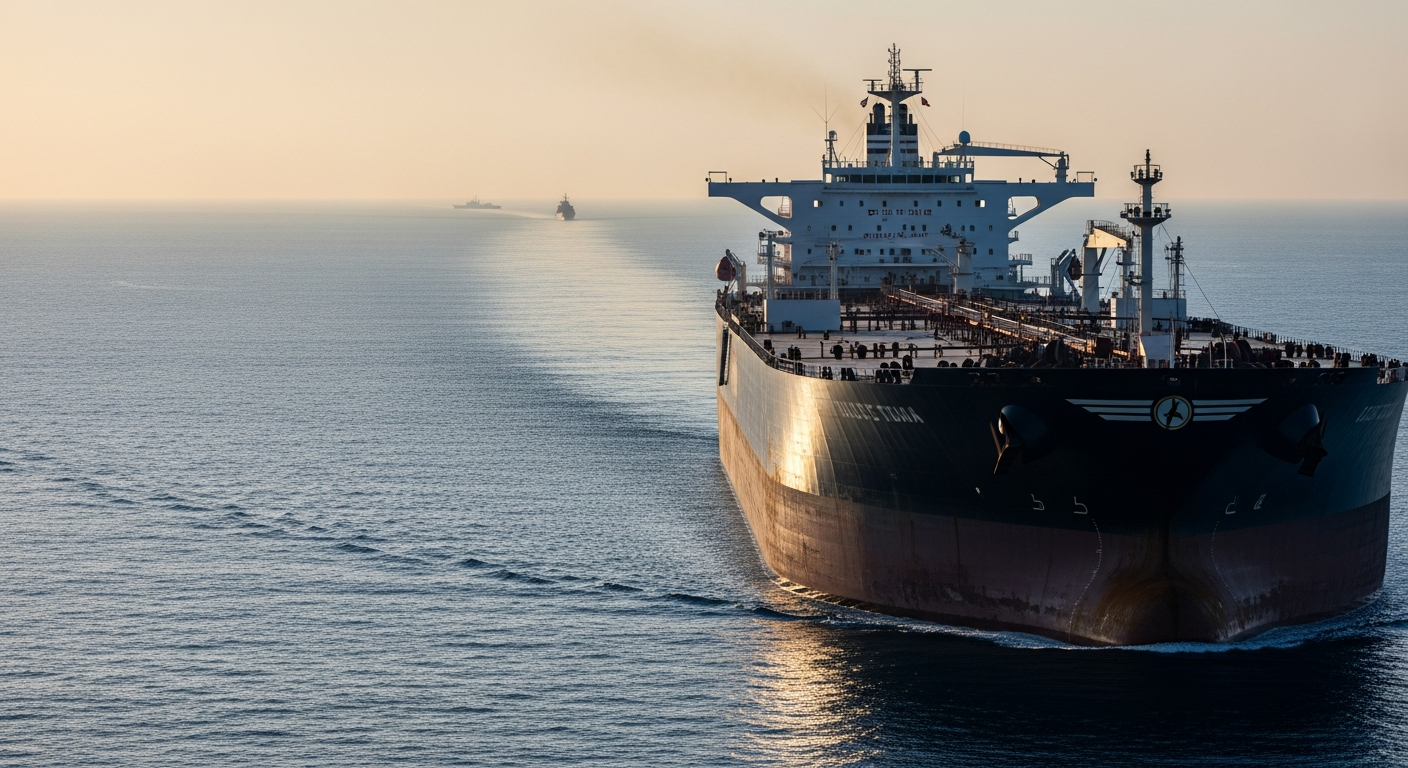
Trump declared the June 17 US-Iran MoU 'over' at the NATO summit in Ankara on July 8, after Iran attacked three tankers in the Strait of Hormuz and CENTCOM retaliated with strikes on 80+ targets. Brent crude surged roughly 6% to around $78-79/barrel. The US Treasury had already revoked the
The June 17 MoU is dead, the sanctions waiver is gone, and Hormuz is back in play, oil markets are already pricing the damage.
Key takeaways
President Trump, speaking at a bilateral press conference alongside NATO Secretary General Mark Rutte at the Beştepe Presidential Compound in Ankara on July 8, 2026, called the US-Iran ceasefire finished. "I think it's over. I don't want to deal with them anymore. They're scum," Trump told reporters, per NPR and Time. "They're sick people, they're led by sick people, and they're vicious, violent people. And if they had a nuclear weapon, they'd use it," he continued, per CBS News and Time.
The remarks landed after a full cycle of escalation: Iran targeted three commercial vessels in or near the Strait of Hormuz on July 7, CENTCOM struck more than 80 Iranian targets overnight in retaliation, and Iran's IRGC then launched missile and drone strikes against US military facilities in Bahrain and Kuwait. Both countries intercepted the incoming fire, with no material damage reported, per Time and CBS News.
The June 17 MoU, signed at the Palace of Versailles during the G7, had established a 60-day ceasefire with a mid-August expiration, per Time and Al Jazeera. Its core economic incentive was the sanctions waiver allowing Iran to sell oil. The US Treasury revoked that waiver (General License X) on July 7, effective immediately for new sales, with a grace period covering cargoes already at sea before that date. A US official quoted by CBS News framed the logic plainly: "The MOU in effect with Iran is entirely performance-based. Iran will only reap benefits if they exhibit good behavior."
Iran's attack on three tankers, the Marshall Islands-flagged M/T Al Rekayyat, the Saudi-flagged M/T Wedyan, and the Liberian-flagged M/T Cyprus Prosperity, per Al Jazeera citing CENTCOM and CENTCOM's official press release, was the performance failure that collapsed that structure. CENTCOM confirmed the strikes destroyed Iranian air defense systems, coastal radar, anti-ship missile capabilities, and more than 60 IRGC small boats.
Trump stopped short of ordering a full resumption of the war. "I'll let our wonderful negotiators keep talking if they want, but I don't see it," he said, per Time.
Before this conflict, roughly 20-25% of the world's seaborne oil and approximately 20% of its LNG passed through Hormuz, per Al Jazeera. Brent had already traded above $100 per barrel earlier in the war, per CBS News. At around $78-79 on a single morning's remarks, the market is not yet pricing a full closure, but it is pricing the removal of the normalization assumption.
That removal has a direct path into CPI. Higher oil flows into transport, manufacturing, and food costs. The Federal Reserve is already navigating a fiscal trap: the US is carrying more than $36 trillion in debt, which means tightening into elevated energy costs produces punishing debt service. Loosening with oil above $80 reaccelerates inflation.
Sustained Hormuz disruption removes that optionality. The Fed's next move becomes constrained by a chokepoint it cannot bomb its way out of. This is a structural energy shock, not a cyclical one.
The dollar-weaponization dimension compounds it. Every time the US revokes a sanctions waiver mid-deal, every non-Western sovereign watching takes another step toward dollar alternatives. Iran cannot use SWIFT. It will settle oil in something else.
The yuan cannot fill that gap structurally (Beijing's capital controls make it impossible at scale). But the pressure accelerates de-dollarization regardless, and it does so in the one asset class where the petrodollar has historically been hardest to route around.
Bitcoin's supply schedule is indifferent to who is firing missiles or printing Treasuries to pay for the response. The macro condition being assembled here, negative real yields, an inflation shock the Fed cannot cleanly address, and accelerating dollar-alternative pressure, is the same condition that has historically preceded Bitcoin's hardest rallies. The IRGC's warning of "harsher" retaliation "in the coming days," per Al Jazeera, suggests this condition has more room to develop.
The falsifiable version of that thesis: if Brent retreats below $72 within 48-72 hours on credible back-channel reporting that negotiations have quietly resumed and Iran re-commits to free Hormuz passage, and 10-year Treasury yields hold or drop, then this is another risk flare with no lasting inflation pass-through. That would be the signal the thesis is wrong for now.
The IRGC's explicit threat of further retaliation sets the next trigger. Watch Brent's behavior above or below $80, any credible back-channel reporting on renewed talks, and the state of Hormuz vessel flows as freight and insurance markets reprice. The NY Fed's June 2026 Survey of Consumer Expectations, released July 7, put 1-year inflation expectations at 3.7%, the highest since September 2023, before this session opened.
Trump approved and ordered the strike package personally from Ankara, convening Secretary of State Rubio, Defense Secretary Hegseth, Treasury Secretary Bessent, and Joint Chiefs Chairman Gen. Dan Caine before the order went out, per Fox News. The targeting list went well beyond air defense: US strikes hit coastal surveillance systems, surface-to-air missiles, anti-ship cruise missiles, drone launch sites, and port facilities. Explosions were confirmed at Qeshm Island and the port of Sirik on Iran's southern coast, but the most consequential strike may have been on Kharg Island, a five-mile stretch off the Iranian coast that handles roughly 90% of the country's crude oil shipments, where Iranian state media reported multiple blasts.
On the sanctions mechanics, OFAC revoked General License X, the sweeping authorization issued June 21 that had permitted the production, delivery, and sale of Iranian-origin crude oil, petrochemical products, and petroleum products, replacing it with General License X1 effective July 7.
The new license authorizes no new Iranian oil sales after July 7, allowing only a grace period until July 17 for transactions already in process, with proceeds from those sales placed into a blocked, interest-bearing account rather than remaining available to Iran.
Iran's Foreign Ministry condemned the move as a violation of Article 10 of the MoU, which explicitly guaranteed oil export waivers, and warned of consequences from the US breach of its commitments.
The supply-chain fallout is already measurable. As many as 63 million barrels of Iranian oil are now either in transit or idling in tankers, per Bloomberg's estimates based on Vortexa data, with oil on floating storage in the Gulf having more than doubled in the past week to over 41 million barrels.
Iran is left with millions of barrels of crude moving or idling across a large area from the Persian Gulf to the Strait of Malacca, with most laden tankers not broadcasting a destination or broadcasting that they are available for new orders.
Asian refineries in Japan, South Korea, Taiwan, and India are acting with extreme caution despite receiving offers, driven by fears of shifting US policy and the potential imposition of secondary sanctions, while EU and UK restrictions remain firmly in place and tanker insurance has grown more complex.
Since the MoU was signed in mid-June, Iran had rushed to load cargoes from Kharg Island and move tankers out of the Gulf as fast as possible, after weeks of virtually no exports during the blockade. Those cargoes are now stranded inventory with no clear buyer. With Kharg Island now inside the US strike zone and 63 million barrels sitting on shadow-fleet tankers that nobody will insure or receive, the market is no longer pricing a corridor disruption. It is pricing a supply destruction event, and every barrel of that stranded oil is a live demonstration of what happens when a state's entire export revenue stream runs through infrastructure that a counterparty can bomb and a sanctions architecture that a counterparty can revoke overnight.
The exchange widened dramatically overnight. CENTCOM hit 90 targets along Iran's coastline, and Iran answered with a coordinated salvo that went well beyond Bahrain and Kuwait. Iran's Revolutionary Guards claimed hitting 21 US military targets across the region, including the Fifth Fleet headquarters in Bahrain, Al-Azraq Air Base in Jordan, and Ali Al Salem Air Base in Kuwait. Jordan said it intercepted eight of ten ballistic missiles fired at Azraq with no casualties or damage reported. Qatar received an elevated security warning pushed to mobile phones, with an all-clear issued within ten minutes noting that a threat had been eliminated. Four Gulf states plus Jordan under active Iranian fire simultaneously is a qualitative shift from anything in the prior cycle. CENTCOM's second-day strikes reached areas that had not been touched since the April ceasefire, with roughly ten explosions reported in Chabahar and nearby Konarak, additional blasts confirmed in Bushehr, and strikes on Abu Musa Island and near Tahrouyi village in Sirik. Intercept rates held across the Gulf, but debris did not stay clean: one person was injured after material fell from interceptions over Kuwait, and debris caused damage at several locations across the country. Bahrain's Defense Force confirmed its forces intercepted and destroyed several Iranian missile and drone assaults. The IRGC's stated target list for the Kuwait package included US Patriot systems, an early warning satellite antenna in Qatar, and a fuel storage facility in Bahrain, confirming Tehran is deliberately probing the air defense architecture protecting US basing across the Gulf.
Two new policy declarations landed on top of the kinetic exchange and carry direct market implications. Trump threatened to launch another "big attack" against Iran and warned that the US Navy could resume its naval blockade of the Strait of Hormuz, less than 24 hours after US forces struck the country in retaliation for Iranian attacks on commercial ships.
The president acknowledged the blockade option carries its own risk, noting Iran could respond by placing mines in the Strait, but stated plainly: "We may put it back, the blockade, and it'll only be a blockade for Iran."
The White House is also revisiting the idea of forcibly seizing Kharg Island, Iran's primary crude oil export terminal. VP Vance layered on the explicit terms from Milwaukee: "The basic deal that we cut was we'll lift our blockade if you stop shooting at ships. But if you shoot at ships, we are going to punch back, and we're going to punch back harder than ever before."
Vance was unambiguous on consequences: "If they try to close it down, there's going to be a response from the American military. It's that simple. That's the deal. They can either follow it, or they can have exactly what happened to them last night."
Tehran's response on the chokepoint itself has been equally direct. Iran's chief negotiator said the strait would reopen only under "Iranian arrangements," signaling Tehran intends to maintain leverage over the chokepoint despite international pressure, and tanker traffic through the Strait was at a near standstill Thursday with just two tankers having sailed through in the early hours. About 6,000 seafarers remain trapped around the Strait, with the head of the UN maritime agency condemning the latest exchanges and warning that "reckless attacks have again placed innocent seafarers in grave danger." On the supply side, Iran shipped out 10 million barrels of crude and fuel overnight per TankerTrackers, a significant ramp-up from the 60 million barrels moved over the prior three weeks per Windward Intelligence, suggesting Tehran is racing to clear inventory before a potential reimposed blockade shuts the door. About 200 million barrels of oil escaped the Strait over the past three weeks, according to Lipow Oil Associates, the equivalent of roughly two days of global demand, and around 60 million barrels of that is Iranian, now sanctioned again with buyers given just ten days to take hold of it before it is off-limits.
Speaking aboard Air Force One, Trump acknowledged Iran had called seeking a deal, but said flatly: "I just don't know that they're worthy of making a deal. I don't know that they're going to honor the deal. That's the problem." That is the live tension: a blockade reimposition would snap shut the same Hormuz corridor that briefly moved 200 million barrels of oil and allowed prices to pull back from triple digits, removing the only inventory-replenishment window the global market got from the June MoU. The threat is the price signal. The Fed cannot bomb its way out of a chokepoint, and it cannot ease its way out of one either.
Treasury moved from license revocation to active designation on Friday. The United States issued new Iran-related sanctions following Iran's resumption of attacks on international shipping in the Strait of Hormuz, the Treasury Department confirmed.
The sanctions target Ali Ansari, an Iranian banker and businessman based in Dubai who had previously been sanctioned by Britain for his role in financially supporting the IRGC's activities. Treasury described Ansari as a "key financier" for Iran's new leader Mojtaba Khamenei, saying he had diverted publicly funded wealth into an extensive overseas portfolio of real estate and commercial holdings to enrich himself, government elites, and the IRGC. The State Department's designation page logged the action under the heading "U.S. Squeezes Iran's Regime Financiers and Shadow Banking Networks."
This is a different instrument than the GL X1 wind-down. Revoking the oil license cut off the revenue tap. Friday's SDN designations go after the plumbing: the offshore financial networks that move regime money when the oil tap is restricted. GL X1's abrupt reversal of GL X underscored the speed at which U.S. sanctions policy toward Iran can shift , and Friday's action signals Treasury is not waiting to see how the kinetic situation resolves before layering on the financial pressure.
The compliance clock is now running on two tracks simultaneously. GL X1 provides only a 10-day wind-down period through 12:01 a.m. EDT on July 17, 2026. Companies with residual Iranian-linked cargoes, contracts, or receivables should prioritize unwinding those positions before the deadline and should not rely on any assumption that the wind-down period will be extended. Any counterparty that also touched Ansari's network or the Iranian exchange infrastructure now targeted by OFAC faces compounded exposure across both the energy and financial tracks at the same time.
The MoU was signed June 17, 2026, at the Palace of Versailles during the G7 summit, per Time and Wikipedia's Iran war timeline. It established a 60-day ceasefire with a mid-August expiration and was structured as a performance-based arrangement: Iran's access to sanctions relief, specifically the ability to sell oil under General License X, was contingent on its behavior. It was not a formal treaty and carried no enforcement mechanism beyond the sanctions architecture the US controls unilaterally.
Roughly 20-25% of the world's seaborne oil and approximately 20% of global LNG transits Hormuz, per Al Jazeera and CNN. A sustained closure would remove that volume from accessible global supply, with no short-term alternative route at equivalent scale. Brent already traded above $100 earlier in this war, per CBS News, under conditions short of a full closure.
Not directly, and not immediately. The transmission is macro, not mechanical. Sustained high oil raises CPI, constrains the Fed's ability to tighten without triggering a debt-service crisis on a $36T+ debt load, and pushes real yields negative.
Historically, negative real yields and dollar debasement pressure have been the macro conditions most correlated with Bitcoin's strongest appreciation periods. The argument is not "oil up, Bitcoin up." It is that the policy response to an oil shock often creates the monetary conditions Bitcoin was built for.