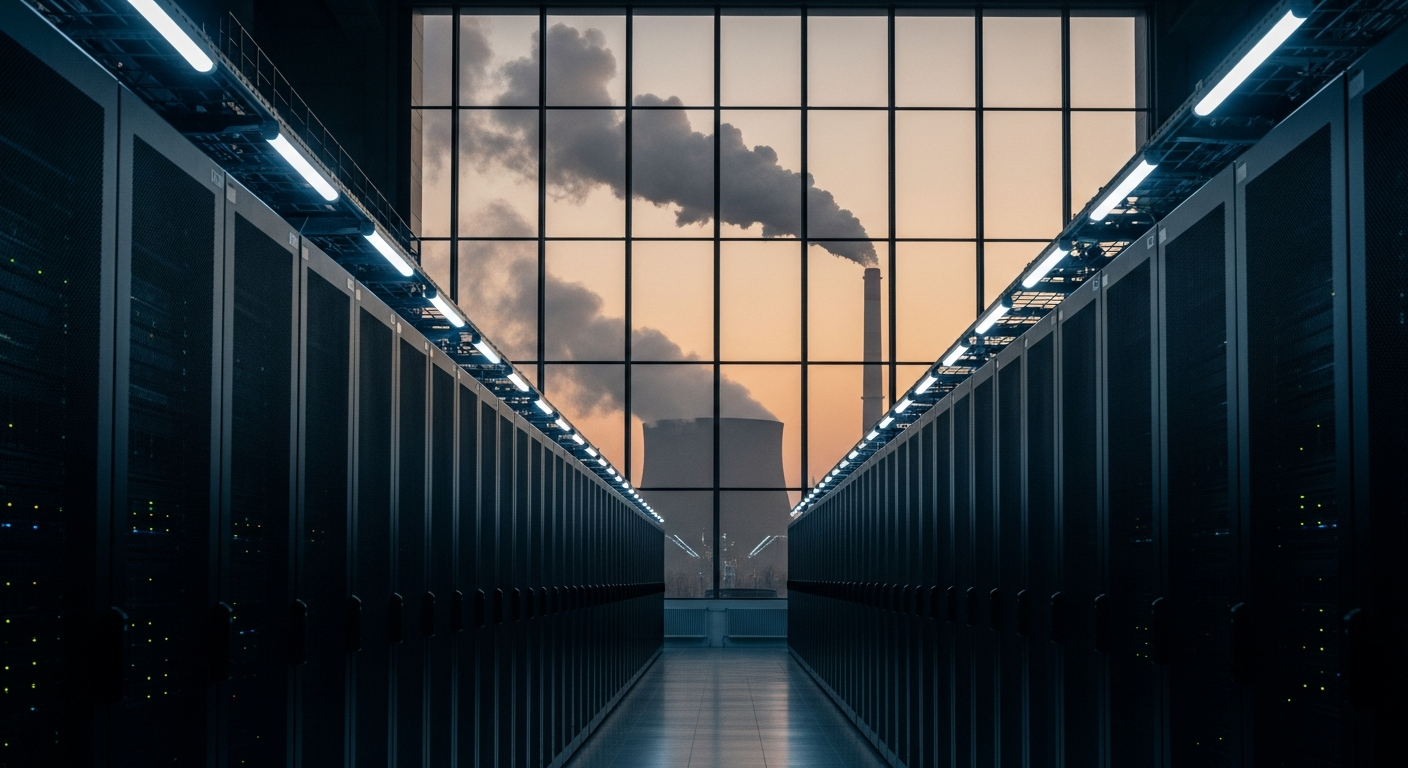
Meta's largest international facility exposes green AI as a PR construct while tightening the dispatchable energy supply Bitcoin miners depend on.
Key takeaways
Meta confirmed July 8 it will build its first Canadian data center in Sturgeon County, Alberta, committing C$13 billion to a 1,750-acre campus that will scale from 1 GW to 1.8 GW. The power source is natural gas. The announced power mix for this specific project, both the Greenlight anchor plant and Capital Power's bridge supply, is natural gas, with no renewables or nuclear in the project's announced generation. The company that has contracted more than 30 GW of renewables globally chose fossil fuel generation for this facility.
Choosing natural gas over renewables is the engineering reality that Bitcoin miners have understood for years, now stamped onto a US$9-10B corporate commitment visible to everyone.
Pembina Pipeline Corporation (TSX: PPL; NYSE: PBA) made its Final Investment Decision on the Greenlight Electricity Centre on July 2, six days before Meta held its Calgary press conference. The C$4.6 billion plant targets in-service in the second half of 2030 and can expand to 1.8 GW. Pembina's partners are Morgan Stanley Infrastructure Partners and Kineticor Asset Management.
Meta does not own the plant. It holds a long-term tolling agreement with the Pembina consortium. Capital Power, a Calgary-based utility, has separately signed a 10-plus year, 250 MW supply agreement drawing on its existing natural gas fleet to bridge the gap until Greenlight comes online.
The campus will require approximately 150 million cubic feet of natural gas per day at full operation, per Pembina's disclosures. Alberta's grid already carries emissions intensity almost five times the Canadian national average. This project does not improve that number.
Alberta Technology and Innovation Minister Nate Glubish put it plainly at the press conference: "Landing the largest data centre project in Canada's history didn't happen by accident. It happened by design." Premier Danielle Smith's government explicitly pitched a "bring your own power" regulatory framework, cheap natural gas, and cold climate as the offer. Meta took it.
Meta's 2026 total capex guidance sits at US$125-145 billion. The Greenlight plant will not be operational until 2030, a four-year window during which AI revenue models, inference costs, and regulatory environments will all shift. If model efficiency improvements continue at their historical pace, the economics of dedicated gas generation at this scale face real pressure before a single watt flows. That is a macro signal about AI capex fragility that connects directly to the fiat-system misallocation pattern running through the broader AI capex cycle.
The sustainable AI narrative always had an engineering problem. Hyperscale compute requires 24/7 dispatchable power. Wind and solar cannot deliver that without storage that does not yet exist at grid scale. Entergy's Brandon Scardigli said the quiet part publicly last August when justifying Meta's Louisiana gas arrangement to Fortune: "Natural gas-fueled generation is the lowest reasonable cost option available that can support the 24/7 electrical demands of a large data center like Meta." That was a Louisiana utility's reasoning for a different Meta project, but Alberta is the same answer at larger scale.
Meta made commitments to 30-plus GW of renewables globally and still chose natural gas generation for its announced Sturgeon County power mix.
This is where AI's effect on the power grid becomes concrete for Bitcoin operations. Meta's Alberta campus will consume 150 million cubic feet of natural gas per day. Capital Power's existing gas fleet is now contracted to Meta. Both were part of the pool of cheap, dispatchable, stranded Canadian gas that Bitcoin mining operations have been monetizing for years.
Miners who locked long-term energy agreements before July 8 are in a stronger position than those still negotiating. Bidding against Meta's balance sheet is a different exercise than bidding against other miners. The competition for dispatchable power is no longer theoretical. It is priced into Alberta's gas market now.
Alberta's "bring your own power" model is also worth watching as a regulatory template. It explicitly told hyperscalers to source their own generation rather than burden the shared grid. That is the same logic that made Canada a favorable mining jurisdiction. If other provinces and U.S. states adopt it, the map of accessible energy for miners changes, opening new jurisdictions while intensifying competition inside the ones already open.
The falsifiable version of this thesis: if Meta announces a firm power purchase agreement for equivalent renewable or nuclear capacity that retires the Greenlight gas contract before its 2030 commercial operation date, with independent delivery verification, the structural argument breaks. A PPA press release with no delivery mechanism does not falsify it. The clock starts now.
Greenlight targets in-service in the second half of 2030. Capital Power's 250 MW gas supply bridges the gap. Construction will peak at 3,000 workers, settling to roughly 300 permanent operational jobs.
Alberta projects approximately C$250 million per year in royalties, taxes, and fees from the project. The political economy in Edmonton is locked in. The open question is whether environmental and regulatory pressure at the federal level in Ottawa, where national AI strategy assumed clean-grid data centers, creates friction before the plant breaks ground in earnest.
Dispatchable 24/7 power is a hard requirement for hyperscale AI inference and training workloads. Natural gas meets that requirement without intermittency risk.
Alberta has abundant, cheap natural gas and a regulatory framework that explicitly welcomed this approach. Nuclear permitting timelines in Canada are incompatible with Meta's build schedule. Renewables without large-scale storage cannot guarantee the continuous power draw a 1 GW campus requires.
Directly, yes. Both industries target cheap, dispatchable natural gas. Meta's 150 million cubic feet per day commitment tightens Western Canadian gas supply available for behind-the-meter mining operations.
Capital Power's existing fleet, which miners could have sought access to, is now under a long-term contract with Meta. Miners with existing locked agreements are insulated; those still in the market are negotiating in a tighter supply environment.
A 932 MW natural gas power plant in Sturgeon County, Alberta, being built by Pembina Pipeline Corp. (TSX: PPL; NYSE: PBA), Morgan Stanley Infrastructure Partners, and Kineticor Asset Management. Pembina issued its Final Investment Decision on July 2, 2026, at a cost of C$4.6 billion. The plant targets commercial operation in the second half of 2030 and is designed to expand to 1.8 GW total capacity.